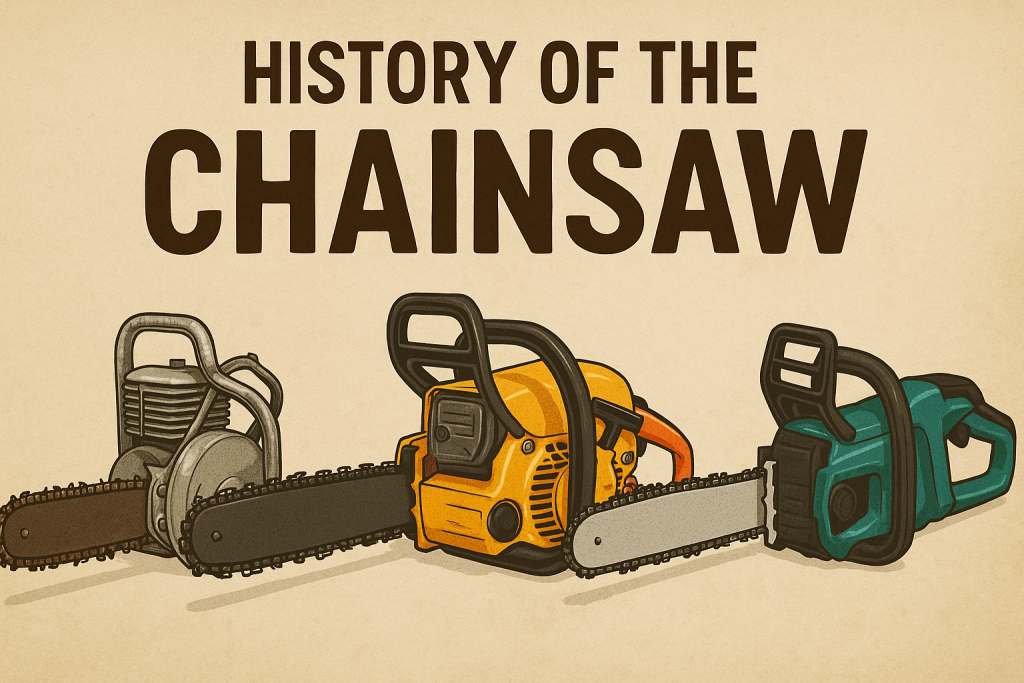
Why were chainsaw Invented? The Gruesome Thruth Behind this Everyday Tool
Many people picture a handyman pruning a tree or a lumberjack chopping firewood when they see a chainsaw. However, the surprising truth behind the Chainsaw Invention History begins in the medical field. Doctors originally designed the tool to assist in childbirth. Over time, engineers transformed it into the powerful wood-cutting machine we know today.
Table of Contents
ToggleEarly Chainsaw Invention : Medical Origins
“Chopping heads” was far more common in the 18th century. Childbirth was incredibly risky for both mother and child due to incomplete parts of the body emerging from the womb. Anecdotally popular in pre-modern surgical aids, the surgery called symphysiotomy involved cutting the pubis symphysis to widen the pelvis.
In the chainsaw history, Scottish doctors John Aitken and James Jeffray played a pivotal role. In the 1780s, they developed a prototype chainsaw that operated using a crank system. Building on this innovation, they created a new vertical saw specifically for cutting bones and cartilage. Their device enabled far more precise and rapid incisions than earlier tools like knives or manual saws, marking a major advancement in surgical technique.
Chainsaw Invention History into Surgical Instruments
Developing off of an initial design of a chainsaw, Heine Bernhard created the first osteotome in America during the year 1830. Remarkably, this apparatus represented a profound advancement in surgical instruments. Differing from modern tools, Bernhard’s osteotome was specially designed to perform cut-bone sawing during a surgery. He incorporated teeth set into a chain and a guiding blade that would allow him to achieve this. Maneuvering the handle caused the blade to turn around the desired area automatically cutting controlled incisions. This development made better precision and speed possible. Orthopedic surgeons made it a primary tool due to these benefits. Its effectiveness and accuracy over time earned it the title of the modern chainsaw’s closest ancestor.
Forestry and Woodcutting Expansion
Although the primary use of the chainsaw was for medicinal purposes, it did not go unnoticed that the chainsaw can serve the purpose of cutting wood. By the 20th century’s first part, the chainsaw had already been modified by inventors to be able to be used in logging. Bens patented this device, an “endless chain saw” in 1905, that was meant for cutting massive redwood trees. Later on, other inventors and gas-operated chainsaw devices gave birth to Emile Lerp in 1920, STIHL, and subsequently other people constructed gasoline-operated chainsaws in and 1930s, which changed the timber industry.
The Evolution and Versatility of Chainsaw Invention History in Modern Times
Chainsaw Invention Across Industries: From Logging to Landscaping
In today’s world, industries such as forestry, construction, and emergency rescue rely heavily on chainsaws as essential tools. Due to the wide variety of applications, manufacturers have designed multiple types of chainsaws including gasoline-powered, electric, and battery-operated models. Whether you’re a professional logger or a weekend gardener, there’s a model tailored to your needs.
Improved Safety and Efficiency Over Time
In addition to variety, chainsaws have undergone notable enhancements in terms of safety features. Because of these improvements, users now experience a safer and more efficient cutting process. Over the years, design upgrades have reduced the risk of injury and increased ease of use. As a result, both beginners and professionals can handle modern chainsaws with greater confidence.
Reflection of Chainsaw Invention History
When considering these changes, the saying “a change is as good as a rest” accurately reflects the technological innovation humans have achieved. In other words, innovation has not only enhanced productivity but also improved user comfort. Therefore, understanding the chainsaw invention history becomes crucial.
Why Understanding Chainsaw Development Matters
In our present time, forestry, construction, and emergency rescue operations use chainsaws as an essential tool. There are many types of chainsaws, such as gasoline-powered, electric, and battery-operated, to suit different needs from professional logging to backyard gardening. Like other technological devices, safety features have also seen improvements, which makes it easier and more efficient to use chainsaws.
As seen from the difference in use, the pathetic phrase, a change is as good as a rest literally stands the truth behind the technological advancement and innovation which humans are blessed with.
By exploring the evolution of chainsaws, we gain a deeper appreciation for the engineering progress behind these powerful tools. Learning about their history allows us to value both their past limitations and present advancements, highlighting how far we’ve come in making chainsaws safer, more efficient, and more accessible.
Concluding the Chainsaw Invention History
The history of the chainsaw’s invention unveils a startling, disturbingly twisted origin far removed from its contemporary use. Starting as a medical tool to aid in a savage surgical operation, it has now transformed into a powerful tool for forestry and construction. The disparity between its roots in an operating room and its current purpose in the logging industry is astounding and unsettling, showcasing the evolution of this device. Thus, knowing this story branches out our appreciation towards modifications made throughout history but simultaneously reminds us how unpredictable the journey of an invention can be. With that said, the chainsaw history is undoubtedly a wonderful piece of human inventiveness, albeit having dark undertones.
📌FAQs
Effective cutting length is the usable part of the bar (from the saw body to the tip), while total bar length includes the part inside the saw, measured when the bar is removed.
Chainsaw bars are sold in even numbers (like 14″, 16″, 18″), so if you measure 17.5″, round up to 18″ for compatibility with replacements and chains.
Yes, most chainsaw bars have stamped numbers showing the bar length and chain specs (e.g., “18” 72DL”). You can also check your owner’s manual for exact measurements.
Related Post
Chainsaw Vibration: How It Affects Your Health and Safety.
Chainsaw Vibration: How It Affects Your...
Read MoreWhat do chainsaw injuries teach us about safety?
What do chainsaw injuries teach us...
Read MoreChainsaw Training for Beginners: Essential Safety & Usage Tips.
Chainsaw Training for Beginners: Essential Safety...
Read MoreWhich chain is better, carbide chain or steel chain?
Which chain is better, carbide chain...
Read More